Showing posts with label wildlife. Show all posts

Friday, November 26, 2010

Sheep hating wolves


My terrier Gordon loves to chase the critters in the back yard. Lizards - yum; frogs - yes, sir. Sometimes he even likes to munch on a toad. Every time he does he drops the little guy and he starts to salivate and foam at the mouth. This is the toads way of training dogs to keep back.

Natural aversion therapy.

Aversion therapy is often used with dogs to convince them not to do this or go there. Really, all your shock collar is is aversion therapy. Can scientists use aversion therapy to convince wolves not to eat sheep?

It is being tried on the reintroduced Mexican wolves of the Southwest.

Reintroducing critically endangered Mexican gray wolves (Canis lupus baileyi) to the U.S. Southwest has never been easy. It hasn't helped that livestock owners hate the wolves. Every month livestock deaths that might have been caused by a wolf must be thoroughly investigated by the U.S. Fish & Wildlife Service (FWS). If any wolves are found to be a problem, they must be caught and returned to captivity. With only a few dozen of the predators left in the wild, every animal counts, and these removals hurt the long-range hopes for the species.

But now two psychologists have an idea to ease that human–wolf conflict: teach Mexican wolves that eating sheep will make them sick, so they stop predating on livestock.

Lowell Nicolaus, a biology professor emeritus at Northern Illinois University, and Dan Moriarty, a psychology professor with the University of San Diego, tried their idea in September 2009 with several captive Mexican gray wolves. According to a report published in the November 2010 issue of Monitor of Psychology, the researchers laced ground mutton with a nausea-inducing chemical called tiabendazole. The chemical has no taste or smell, so the wolves were not able to detect it. But after eating the contaminated meat, the sickened animals later refused to eat more sheep flesh.


Read more here.

Saturday, November 6, 2010

Found in the Mountians


This marbled orb weaver was found hidden in the leaf litter on the mountain. She was one of the coolest spiders I have ever found.

Mountians to coast


Last weekend was a busy one.

It started with an unsuccessful hunt. The cover here is still so thick, wading through it is tough enough, but the squirrels are able to just disappear.

We saw plenty, but Tess wasn't able to connect.

So I loaded up the car and picked up my coworker, Lee, and we headed west.

It didn't take long before we started to see signs of Fall. On the Outer Banks we don't get a real fall. Eventually, the leaves turn brown, curl, and fall. But many of the trees, the live oaks especially, don't lose their leaves. We don't get that spectacular change.

So it was nice to see some vibrant leaves.

Before long, the road began to undulate, up a hill down a hill, and there were mountains in the distance.

We were spending the weekend with the NC Museum of Natural Science searching for elk.

The experimental release of elk into Great Smoky Mountains National Park began in February, 2001 with the importation of 25 elk from the Land Between the Lakes National Recreation Area along the Tennessee-Kentucky border. In 2002, the park imported another 27 animals. All elk were radio collared and were monitored during the eight-year experimental phase of the project. In 2009-2010, the park began developing an environmental assessment of the program and a long-term management plan for elk. Project partners include the Rocky Mountain Elk Foundation, Parks Canada, Great Smoky Mountains Natural History Association, Friends of the Smokies, the U.S.G.S. Biological Resources Division, and the University of Tennessee.

Elk once roamed the southern Appalachian Mountains and elsewhere in the eastern United States. They were eliminated from the region by over-hunting and loss of habitat. The last elk in North Carolina was believed to have been killed in the late 1700s. In Tennessee, the last elk was killed in the mid-1800s. By 1900, the population of elk in North America dropped to the point that hunting groups and other conservation organizations became concerned the species was headed for extinction.


We were here to see if we could find them.

We woke the next morning to cold and frost. I could see my breath as I peeked outside the cabin to check the weather. 15 educators loaded into a van and traversed the switchback laden road over the mountain and into Cataloochee Valley.

The trees opened up around the road and there they were. One big bull elk and his harem of females. The were silent, munching on the valley grasses steam rising off of their frost covered backs. Then the male rose its head and bugled smoke rising from his snout. The sound echoed.

The teachers were giddy. we watched them for hours as they fought, bugled and the males tried to make their advances.

These elk were reintroduced from a Canadian herd and tend to be smaller than the elk out west. But they were still impressive.

We spent the day hiking and observing the herd. Turkey would wander the fields with impunity as we were involved in talks from the park rangers and educational staff.

The valley filled with tourists, there for the same reason.

We left late in the afternoon after being educated on terrestrial snails, lichen, and the blight affecting the smokey mountain hemlock trees.
Saturday night we celebrated elkoween; lame costumes and cheap wine. It was fun.

Sunday was more of the same - with the elk ever present in the valley.

It was a good weekend and I learned a lot. I will be spending more time traveling with the museum.

We left in the afternoon, our brains full and jiggly.

We spent Sunday morning doing the same

Saturday, December 26, 2009

Frounce is an age old problem

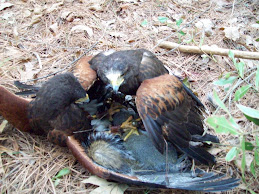
Frounce, or Trichomoniasis, is a disease that is often transmitted to falcons through eating pigeon. It is defined on the Modern Apprentice website this way:

Frounce is a highly contagious yeast infection of the digestive tract. Frounce is caused by a protozoan called Trichomonas which is frequently present in the crops of pigeons. For this reason, pigeon heads and crops are generally not fed to raptors. The typical signs of frounce are white spots in the mouth or crop, often described as "cheesy" or "white plaques."

Picture from here

Frounce is very often deadly to falcons if it is not treated quickly. Transmission happens through bedding or beak to beak contact in dove species and falcons are infected when they eat pigeons. DNR tells it this way:

Transmission of T. gallinae occurs by discharge of bodily fluids in one of four ways. Adult doves and pigeons infect their offspring during feeding, infect other adult birds through contaminated food, water, and bedding and via courtship behavior. Raptors are infected through consumption of infected doves or pigeons.

This is a disease primarily of doves and pigeons and is transmitted from the adult to their offspring by the regurgitational method of feeding used by these birds.

But this disease is not only deadly to raptors today (I'm on a binge here). It has been theorized that Frounce has been around much longer than previously thought. Scientists believe that many parasites develop along with their hosts, so today's bird parasites, were yesterdays dinosaur parasites. An article for National Geographic News states:

After surviving countless battles, a giant T. rex was ultimately taken down by a microscopic parasite akin to one carried by modern pigeons, scientists say. The finding is a new interpretation of multiple holes in the jawbone of "Sue," the largest and most complete Tyrannosaurus rex fossil yet found, which is on display at the Field Museum in Chicago.

And goes on to say....

In a new study, researchers instead propose that the holes are lesions made by an ancient version of trichomonosis, a single-celled parasite that infects the throats and beaks of modern birds.

So if you worry about your falcons - especially if they have ever (I mean ever) fed on doves or pigeons - treat them for this ancient disease that has preyed on them for millions of years.

Saturday, June 20, 2009

Skunk mom


No real post here, just a great picture from The Camera Trap Codger

First Wolverine in Colorado in 90 years.


Wolverines have been absent from the state for close to 100 years. But scientists have tracked one making the voyage into Colorado.

A lone male wolverine arrived in northern Colorado earlier this month, making him the first confirmed wolverine in the state since 1919.

In December, conservation biologists had outfitted the young wolverine, which is part of a reintroduction program farther north, with a tracking collar and watched him make the 500-mile (805-kilometer) journey from the Grand Teton National Park in Wyoming, crossing rugged landscapes and even busy Interstate-80, reports the Denver Post.


Read the rest at 60 Second Science

Friday, May 29, 2009

Snakes

On a daily basis I check the chickens.

They live in a small 4 x 4 coop with an attached wire run off the side of the shed. Most days they spend sunning themselves on their perches or rolling in the dirt to rid themselves of parasites. Right now I have about five full grown chickens and a bunch of babies. Only four of the chicks were actually hatched by the hen that laid them. The rest of them were incubator babies.


The peepers that hatched in the coop are being raised by momma and I worry about their progress. They are pretty well protected in the coop, but there are always things that can get at them, including the other chickens. I went to pick up the eggs yesterday. I usually get one or two a day, which is just the right amount for our family, but today there were no eggs.

I opened up the side compartment. Inside there are two small nest boxes. Perches line one wall, and the whole area smells faintly of hay and chicken guano. To be honest, it smells like my grandmothers farm.
I pull the door aside, and the dusty interior of the coop is filled with the mid day sun. ‘I need to clean out this house.’ I think to myself.

That’s when I saw it. It was black and slick and coiled up in one of the chickens nest boxes. A black snake. Crap.

I walk back to the shed a retrieve a garden glove. Generally, black snakes are pretty docile, but you never know what you are going to find. I reach my hand inside the box and start pulling. The thin tail stretches out of the box, and I can feel the muscles of the snake contract in my palm as it tries to pull away. I reach in with my other ungloved hand, trying to keep the snake from getting tangled up in the structure of the nest box.

Foot by foot it pulls out until five feet of snake stretch between my hands and the chicken coop. I slide my hands forward and untangle the head from the uprights of the nest box. I extract the snake the rest of the way out, feeling the lump in its midsection, which I assume is the egg that it has already eaten. The snake is docile, harmless. He lets me handle him like he’s been a pet his whole life.

My wife’s mantra is the only good snake is a dead snake. I don’t agree. The boys and I have a program for visiting snakes. They can come and live in our garage for a time, and then we let them go again. This snake was a prime candidate. I placed him in an aquarium where we could observe him.

Then I took him to school to show the students.

We spent the day talking about snakes, their habitats, and how they are good for the environment. The children touched and stroked this perfectly mild mannered serpent. I hope I made an impression on some of their little minds.

On the way home, I let him go.


He was no worse for wear, but he ended up doing a lot of good.

Tuesday, March 17, 2009

Crows in the Trees

When I got home from work this afternoon, there was a ruckus in the trees near the hawks cage. The birds have been fat, their crops full. I hope that the birds were okay.


I rounded the corner of the shed and verified that the hawks were fine.
Blue Jays were calling back and forth and I could see them swarming around the top of a live oak.

Two crows swooped in and circled the center of the commotion. It looked like the crows were possibly raiding the jays nest.

I moved closer to get a picture, but the birds were obviously more afraid of me than of each other and fell silent.


The crows secreted themselves away, weaving low through the trees. One of the jays giving a final kak as he gave a brief chase.

I know that there is a crows nest some where back in the woods. I would love to find out where it is.

Crows are cool creatures. They are right there at the top of the list for intelligent creatures. They have been observed using tools, they are believed to have a culture of sorts, as well as their own language, that goes beyond simple vocalizations.


Keep an eye on your local crows. There are myriads of stories of people who have raised orphaned crows to become cool pets. I never have, but would love to try. Unfortunately, in the U.S. this is an illegal endeavor.