Showing posts with label falconry. Show all posts

Saturday, May 21, 2011

Kestrels compared


I'm thinking a lot about what is going to happen next season and the idea of a kestrel has cropped up more than once. Then I saw this little nugget over at Little Mews on the Prairie. It is a great little article about the differences in kestrels and how to tell a passage falcon from a hag. I have a hard time with this, but the pictures really help.

Sunday, November 7, 2010

Great morning


Johnathan came up from Jacksonville yesterday for a morning of hunting. He brought his sharp shinned hawk and we started off with some car hawking.

I have always understood that accipiters are crazy, high strung, and often difficult to hunt. We trapped one last year and I considered hunting with it, but soon let it loose as I was not up to the challenge.

Johnathan's little girl dispelled many of these myths.

Johnathan is a hawkers - hawker. He maintains this little bird impeccably and hunts her everyday. After about 26 days, she already has 29 kills. Her primary mode of hunting; car hawking. And, once we figured out she didn't like my Steelers baseball cap, she was well mannered riding unhooded in the car.

We rode around looking for the right slip. It was later in the morning than we would have liked (Johnathan had driven up just that morning), the wind was blowing and rain was spitting off and on.

Conditions could be better.

We tried two slips on starlings. The bird missed, both times. Johnathan was frustrated. Then the bird flew and landed in a tree. It took a few minutes, while the restaurant manager, whose parking lot we were idling in, gave us dirty looks.

The bird came down to the lure, and we decided to give the sharpie a rest.

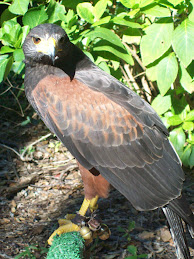
We went back to the house and loaded up the harris hawks. They were both fat, as I had fed them up a few days before in anticipation of a cold front that never came.

Tess was working hard, Gonzo - not so much. We had a few squirrel chases where the squirrel won by either getting in a hole, or scampering to the top of a giant pine. The hawks were not motivated enough to follow.

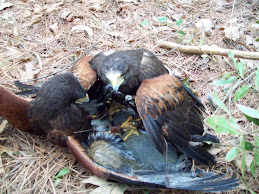
Suddenly, Tess cruised low, then crashed to the ground. I stumbled over, more curious than hopeful, and she was on a squirrel HA !

Score one - but wait. This squirrel was dead, and already partially eaten. That's when we noticed the red tail screaming at us from overhead. Apparently we had scored anther hawks kill.

Doesn't count (though it still goes in the freezer).

We waded on. A chase quickly ensued. The leaf cover was too thick to see any of it, but it ended with Tess gliding to the ground, squirrel in her talons.

We wandered a bit more, but it was getting late, so we called it a day.

On the way back to my house we noticed a flock of starlings across the street that looked ripe for the pickin'.

We switched vehicles and got the sharp shin ready for another try.

We cruised by slow, checking it out. The hawk was on Johnathan's fist, ready to go. But every time we passed, the flock flew. Johnathan, though good natured about the day, was frustrated.

We pulled into a parking lot behind the flock, and there was a single starling, hopping amongst some rocks on the edge of the blacktop.

Johnathan nudged the car forward,and dumped the hawk out the window.

It disappeared below our line of sight.

Damn.

Then it creamed into the starling, grabbing it and carrying it into a thicket.
I could hear the starling yelling the whole way in.

Slam, park, run.

She was hidden amongst the leaves getting control of the bird. The starling screeched as the sharpie adjusted its grip.

Johnathan came in, pushing aside the vegetation and began tidbitting. The bird accepted the offerings greedily.

Johnathan let her eat, then transferred her off neatly.

Awesome.

Saturday, November 6, 2010

Eagle/ harris hybrid

I've never seen one, but this is a picture of a golden eagle- harris hawk hybrid.
I wonder if they hunt cooperatively? They're probably too big for squirrels.
If you live out on the open plains and hunt jacks - this might be the ticket.

Patrick goes on to write a great article about hybrids and hybridization. Take a look.

Tuesday, July 20, 2010

Tuesday, July 13, 2010

Is this you?


From the Encyclopedia Brittanica

Long Time Coming


I don't know what the numbers are for falconers that belong to their local or state falconry club - but you should be involved.


I got a series of emails yesterday. One was from the North Carolina Wildlife Resource Commission and the other two were from NC Falconers Guild.

What did they say, you ask?

2010-11 Fishing, Hunting and Trapping Regulations also Effective Aug. 1

RALEIGH, N.C. (July 12, 2010) – The proposed hunting and trapping rule changes approved by the N.C. Wildlife Resources Commission in March 2009 but delayed for legislative review will go into effect on Aug. 1, 2010.......

Then there was lots of lawyerspeak, and about halfway down the page it said..


  • Allow falconry on Sundays, except for migratory game birds.

Yee - Haw!!

It has been a few years now that NC falconers have been working on getting Sunday falconry allowed, and it has finally happened. It has taken public meetings, letters, emails and a few well placed words to local senators. While I cannot claim to have played any sort of pivotal role, I did play, and it took lots of people to make this happen.

This is a huge breakthrough for me, as I often hunt in the same areas as deer hunters. We've come into conflict before.

My hunting is loud and fast as I chase squirrels through the canopy (I'm not usually in the canopy, that would be the squirrels) - deer hunters often don't like this. ( though I had one guy thank me for flushing the deer he shot).

Sunday hunting takes me out of conflict with those deer hunters. It should open up areas for hunting earlier in the season.

The season is coming - time to get ready.

Friday, July 9, 2010

Change of focus

It's mid July - the height of my lack of falconry.

But three things happened just recently that has made me reevaluate my state of mind right now.

Normally, by now depression has set in. If you haven't read much about falconry and falconers - the sport is often described not as a hobby - but more of a life style. Some even go so far to say that it becomes an addiction.

I lean more towards addiction. For many, when you are not hunting, your thinking about it, yearning for it. For many, your looking for your next fix.

This time of year is the depressing doldrums of nothingness.

But three things happened just lately to change my focus.

1. Changes in the laws
I got a call from Andrew the other day. He is my former apprentice and friend. We hunt together most of the time. Anyway - he had been involved in some legislative wrangling and he called to tell me that Sunday hunting for falconry may become a reality in the coming season. yoo - hoo!

2. Mail
I got a letter from Fish and Wildlife renewing my propagation permit. While the letter was welcome, it made me realize that my raptor breeding has been a bust again this year. Neither of the birds seemed in the least bit interested in pursuing each other romantically. I need to close the door between their cages and start monitoring their weight again.

3. Call
I got a call from someone over the weekend. He lives a few towns over and has been "interested in falconry his whole life". It looks like I may be getting an apprentice. This will only be my second in my falconry career - but I kind of live on the end of the earth. He isn't in a position to trap a bird this fall, so the next year will be devoted to studying his books and building his facilities. He'll be spending the winter hunting with Andrew and I - and figuring out if this is what he wants to do.

What's it all mean?

It's time to get ready. Really, falconry season is just around the corner. Trapping begins in less than two months, squirrel season opens soon after.

Time to get permission to hunt on other people's land.

Time to get out the nets and BCs and trapping equipment.

Time to start securing bait animals (I can never trap enough starlings).

Time to order leather and make new equipment.

Time to figure out what birds I want to fly next year - Do I want a falcon?

So much to do - it's time to focus.

Sunday, December 6, 2009

A plea from American Falconry


I received this in an email the other day and it made me sad. There are too few magazines dedicated to our sport out there. If you are a falconer, or just interested in becoming one; subscribe! Read the whole letter.


November 29, 2009

You may have noticed Volume 52 of American Falconry magazine is behind schedule. After 14 years of bringing you American Falconry, I'm afraid we have some disturbing news. Our revenues have dropped by almost 50% this year. We have always enjoyed bringing the magazine to you, and while we are willing to continue working for no pay, we can't fund the printing cost out of our own pockets. The solution we have implemented is to delay printing issues until sufficient funds to pay for the printing and mailing are in hand. We are close to having enough for Volume 52 but still have a ways to go.

We intend to send you the same number of magazines you paid for. A one year subscription is four issues, even if it takes longer than a year to receive them. If you'd rather not wait so long for the next issue to come out, please talk to your buddies and get them to subscribe, or better yet buy them a gift subscription. You could even renew your subscription early. In the event that income doesn't improve, and we are forced to cease publication, we will fill the remainder of your subscription with back issues of your choice from available stocks. This decision will come early next year. The future of American Falconry magazine is truly in the readerships hands.


Click here to subscribe.


Monday, October 19, 2009

Dropping weight


It has finally cooled off a bit here in NC. At least enough that I had to wear a jacket to work today. It is about the time that passage Red tails start their migration south in any numbers, and the trapping of them begins in earnest. It is also the time when I expect my hawks to be at a good hunting weight.

In the summer the birds are put up to molt (grow their new feathers). I feed them too much and they get fat and belligerent in their summer quarters, But now I am ready for them to be ready to hunt. This is not starvation! This is getting the birds down to fighting weight, like a runner, or a boxer.

To drop a birds weight, the obvious thing is to just stop feeding them, but that doesn't work. Raptors are built to go for long periods with little food. If a hawk stops eating, their metabolism simply slows down and they don't lose any weight. The best thing to do is to feed them a bit less every day. This keeps their system revving on the food they are getting, but at the same time you are cutting the birds caloric intake.

It is vital that you keep a close eye on their weight. In bigger birds, that means weighing them at least daily. In the smaller raptors, they may need to be weighed multiple times a day. Calories are then adjusted and the math is done to figure out the amount of weight lost over a set period of time and how much food needs to be fed.

My birds are still losing their summer weight, slowly. It will warm up this week, but I hope to have Tess where she needs to be this weekend. Gonzo may take a bit longer, but either way, I am hoping to have the birds first kill of the season under my belt by the end of October.


Wish me luck.

Sunday, September 13, 2009

Save the Wine

Around here, we take the whole family out and pick the wild grapes which grow prolifically on our little island. Sometimes we head to the mainland and pick blueberries or strawberries. The kids help us make jam or syrup, then we put the rest in a big bucket and get the kids stomping the fruit for wine.

Apparently, starlings are a big problem for grape growers and they need to figure out ways to reduce their losses. I've heard of owl boxes being built and surrounding a farm to protect them from destructive rodents. Many vineyards are finding that nothing is quite so effective as a good falcon in the air if you want to protect you vines from the birds.

It’s harvest time for California’s winemakers, and no one knows that better than starlings. The grape-loving birds can eat their way through a vineyard pretty quickly. Over the years, wine growers have tried a number of methods to scare the birds away, and some are now turning to an ancient art: falconry.

On one early morning in the Camatta Hills Vineyard, falconer Tom Savory and his crew are on the job.

“The birds, the dog and myself — we are a team,” he says. Their small camper truck rolls slowly over the dusty dirt road. Sadie, his dog, sits up front. And behind them, sitting calmly on their own perches, are five falcons.

It’s the falcons’ job to scare off the starlings in this vineyard, where Savory stops his truck.


This would be the perfect job. But then I have to wonder - if it is your job, do you one day wake up and resent having to go out and fly your falcons. Do you not want to go to work?

Check out the article - there is video to go with it from NPR. Thanks Falconry Today.

Monday, September 7, 2009

Falconers in the news

This is a good article with a nice basic overview of Falconry in America. It discusses caloric intake, the apprentice system, as well as the use of wild raptors for falconry.

“It’s not just a sport, it’s a way of life,” says Spence Wise, a Merritt Island resident and avid falconer. “It isn’t like other sports that you can put aside for awhile, it’s a full-time commitment.”

Sportsmen interested in becoming falconers must first obtain a permit from their state and federal wildlife agencies, a process that can take up to a year or more just for apprentice status. Also, a written exam acknowledging the hunter’s understanding of raptor care and handling, safety, equipment and laws pertaining to falconry must be passed.

Falconers must be able to house a raptor in a large enclosure, known as a mews, which must be inspected by a game warden. Once the housing is approved, the warden may return at any time to ensure the bird is being properly cared for.

As an apprentice hunter, one must practice the art of falconry under the guidance of a sponsor, a previously permitted and licensed general or master falconer who has been hunting for two to five years. Apprentices may practice falconry on their own after two years. They must trap their own juvenile, wild raptors.

Hat tip to Falconry Today for this one. Read the rest here.

Sunday, August 30, 2009

Getting ready games


I don't remember who coined the term, but it fits. These are the games one engages in whilst getting ready for the main event. Fly fisherman tie flies, bow hunters practice their shot, bird hunters shoot clays. We all have our things. My father is home right now making his own bullets in preparation for elk.

Falconry, of course, had its own games. Some would consider trapping one of those. I do not, I think trapping is an art all unto itself. So, what would an ancient art like falconry need to get ready.

Most of it involves making the supplies necessary to be prepared for the season. I am no artist when it comes to falconry supplies. There are many who are. My equipment is serviceable and that is about all. But I know what works for me.

Tonight I made some Jesses. These are the thin strips of leather that attach to the anklets on the hawk. These are large, as Andrew is hoping to possibly get a large red tail if the peregrine trapping doesn't work out.

I looked through my supplies and found that much of what I have is old. I need to make some more supplies.

Anyway - Here I took some leather and cut it into strips.


I fold over the edge and then punch a hole in it, then I thread the end back through to create a button.


I punch holes in the end so that I can thread a clip through it, and there I have two completed Jesses.


I need to make a few more sets of these along with the anklets, I could try to make a hood, but that seems silly as I don't use them. (Some people out there are gasping at that, but I've never had the need)


I also need to start thinking about what I need if I trap a merlin. Hmmmm So much to do.

Saturday, August 29, 2009

Trapping Peregrines in Georgia


It's not just in North Carolina. Georgia falconers now have the opportunity to trap first year peregrines on their coast.

With the comeback of the northern peregrine falcon along the East Coast comes the limited return of opportunity for hunters to capture the birds for use in falconry.

“We are restoring a prized opportunity that was taken away from falconers several decades ago,” said Jim Ozier, a wildlife program manager with the Georgia Department of Natural Resources. “We believe opportunities for traditional, regulated and sustainable wildlife uses should be permitted and safeguarded when possible.”

This week the Georgia Board of Natural Resources approved regulatory changes allowing the capture of no more than five migrating juvenile peregrines along the state’s coast this fall.

You can read the rest here.

Lapses in judgementor missed opportunities.

Have you ever had a situation that if you could do it all over again, you would? I had one of those recently. I was looking at a situation so hard from one side, that I completely considered it from the other, and maybe I had a lapse in judgment. More importantly, I disappointed a friend.

I suppose it happens to everybody. Not too long ago a friend of mine was bow hunting. He'd been watching this deer for quite some time and had been poised for the shot, but the perfect shot never presented itself. So instead, he thought that the shot he had was good enough - even though he knew he was too high, and the angle was wrong. He took it anyway.

It was the deer that suffered. The arrow hit it high on the neck and the deer was off. They trailed it for as long as they could, but the blood trail was minimal. Then they lost it.

They found it two months later, during gun season. It was shot with the arrow still hanging out of its neck. Taking the shot was a lapse in jusdgment.

He could have waited for a better opportunity.


When I discovered that Gonzo's anklets were riding high, I didn't think much of it. I thought that they would work themselves down. No harm, no foul. I hindsight, I should have investigated. Had I, then gonzo would have never suffered that leg injury last month from the abrasions.

Missed opportunity. I should have investigated.

I'm sure every one of you can look back and think of a time that, maybe, you should have thought a situation through more thoroughly before you acted. If you had - maybe you would have done something differently.

Working with animals is full of risk. It starts when you pull that first red tail out of the sky and ends only when you release it again. Risk, risk, risk.

The trick is to minimize it as much as possible. Use telemetry. Fly your birds at the right weight. Pay attention to their outward signs. I'll try and do the same.

Monday, July 27, 2009

Do You Really Want to Become a Falconer?


What does it take to be a falconer? Why would someone want to do it. Isn't it easier just to pick squirrels off with a .22?

Falconry is not for everyone, of that there is no doubt. It takes considerable dedication to your birds and your sport. Falconry is one of the most highly regulated hunting sports out there, so taking it up cannot be taken lightly. But in the same breath, I will tell you that it is immensely frustrating but even more rewarding,

Like other field sports, it is important that all licensed falconers (and all falconers need to be licensed) practice their sport with the utmost integrity so that only good impressions are given to non falconers.

If it is something in which you are really interested, I recommend hooking up with your local falconry club. There are clubs and falconers in most states in the US, and simple Google searches will normally find them for you.

I'm reprinting a letter from the North Carolina Falconer's Guild. It takes time and consideration before someone can really do this.

Falconry is time consuming and it is a highly regulated sport. (see NCWRC and USFWS regulations)

The time spent in training a hunting bird is great. But this time factor pales in comparison to the daily time in providing for the hawk's comfort and care. Food must be of the most natural variety and is not something that you find at the local supermarket's pet section. Hunting birds must be handled, weighed, and looked after daily in order to be successful at catching game. The utmost attention must be paid towards their health and well being.

The legal aspects of becoming a licensed falconer would seem somewhat overwhelming to many. Because birds of prey are protected by Federal law, having one is highly regulated by both State and Federal regulations. These regulations were originally written in order to ensure that, by law, the birds would be adequately cared for and would indeed be hunted with and not merely a pet. Falconers feel very strongly about the regulations and their enforcement. New falconers are required to serve a two year apprenticeship under an experienced falconer, score 80% or better on a comprehensive test relating to falconry, raptor biology, and health care of the birds, and build housing (inspected by the state game officials) that meet set requirements.

This is not to say that becoming a falconer is impossible. But all of these difficult requirements help to insure that only people dedicated to practicing the sport in a quality way are likely to participate.

If after considering all of this, you still would like to learn more, click here.


Monday, June 8, 2009

Great Falconry Article

A hat tip to Falconer on the Edge. They shared a great article from which comes this quote:

Men should not relieve themselves when hunting with hawks, as the hawk will see your, er, appendage as prey. According to Shaun, a falconer at the English School of Falconry in Bedfordshire, this rule was introduced after an actual incident. Ouch. I’m delighted to meet Shaun, mainly because I think “falconer”—along with “spy”, “explorer” and “I play guitar in U2”—is one of the coolest answers you can give to the question “What do you do for a living?”

While I don't agree with the above stated rule, I do recommend that you hide yourself behind a tree before you relieve yourself while hunting.

I recommend you read the rest here. It made me laugh out loud (I will not type LOL).

Wednesday, May 20, 2009

How it starts

When people find out that you are a falconer, they respond in many different ways. You get everything from curiosity to disdain. My favorite response came from a gentleman from a nearby town. It came up in casual conversation that I trained hawks and falcons to allow me to hunt with them. He looked at me incredulously,
“That’s so..” He searched for the right words, “old school.”
He nodded approvingly, and we continued to discuss the ins and out of falconry.

The question I get asked most often is “How did you get started with falconry?” I think the answer to that question is different for every falconer. Some are involved in wildlife rehabilitation, some love hawks. Some are lucky enough to know a falconer with whom they can tag along.

I like to think that people often get to see the birds up close in some educational venue and then get interested. For me it wasn’t like that.

See, I like to write.
I was trying my hand at the great American novel. It never got finished as I was side tracked. The main character in this story hunted with a hawk. It would have been similar to a red tail, had I known enough at the time to make the comparison.

My wife commented that it would be smart to research falconry if I wanted my main character to be true to life (and to this day, I blame her). So I started looking. I found the North Carolina Falconer’s Guild and attended a meet.

There were hawks everywhere and they were amazing. Admittedly, most were red tails. The first one to fly was too fat and unresponsive. We didn’t even get it to fly out of the parking lot before the apprentice who was working with it called it down.

The second set of birds out was a pair of Harris hawks. We wandered through the woods looking for squirrels. We didn’t find any. But the birds, these large intimidating birds, followed us through the woods. I would find myself stopping and watching as they dated from tree to tree. I would lose them when they landed, but the bells would soon give them away.

That was it. I had to become a falconer.

Ten years have passed since then. I’ve had talons through my hand, blunt eye trauma, slips, falls, and multiple briar wounds. But I wouldn't change a thing.

Wednesday, April 15, 2009

Releasing Ate'


Andrew let his red tail Ate' (rhymes with Latte') go the other day. He was a good sized male (tiercel) bird that hunted around 36 oz. His first season he was killer on squirrels, then this season his motivation seemed to be lagging a bit.

Andrew fiddled with his weight, but Ate' just hasn't seemed like he has been interested in the game this year. So, after two years, he's fed him up and let him go.

Many falconers in NC will fly their birds for just a few years and then return them back to the wild. I know that I've done it a bunch of times. That is one of the cool things about falconry, you can take a wild bird and borrow it for a few seasons. The bird gets a chance to learn how to hunt in an environment where it isn't going to die if it misses its next meal (avoiding that 75% mortality rate in the first year statistic), and you gt to participate in its life for a few short years. Then you can release a breeding age bird back into its population. No harm, no foul.

Both of you are better off for it. Yeah, its cool.


We'll be out looking for a new bird for Andrew this coming fall. I'm sure I'll be posting pictures. It looks like it may end up being a busy trapping season.

Tuesday, March 10, 2009

Peregrines


The history of falconry revolves around the peregrine falcon. There are few other animals who better epitomize the conservation efforts of the American people. It is the majestic bird that was flown by the kings of Europe in the middle ages.

And then in the 70's, the use of the chemical DDT caused the extinction of this great bird in the eastern United States. Through the efforts of falconers across the country , and the Cornell Lab of Ornithology, the peregrine falcon was brought back from the brink and is now thriving across the nation. There are more peregrines now than there ever has been.


Isaac, over at Another Falconry Blog, puts out the call to action to help Florida falconers. The very same group of people whose efforts brought the peregrine falcon back need your help.

Isaac writes:

For many years falconers have been prohibited from capturing wild peregrine falcons to use in falconry due to their endangered status. Any peregrine falcon that you see used as a falconry bird these days is from captive bred stock. However, now that the falcon has been delisted and their population is stable, even increasing, falconers may have the opportunity to once again fly their wild counterparts.

In Florida, regulations are being considered to allow falconers this chance but are facing significant opposition from the Audubon society and their "look but don't touch" mentality. Comments are still being accepted regarding the regulations and I urge any and all to write a brief email supporting the idea of allowing falconers to utilize this resource. It seems a very small reward compared to the tireless efforts of those falconers who worked to bring the bird back in the first place.

Below are some talking points (forwarded by the Florida Hawking Fraternity) you could consider in your emails:

The residents of Florida should not be denied access to a natural resource, which harvesting of the Peregrine falcon should be considered as.

Management of peregrines for use in falconry should be based on sound biology, not politics.

Healthy raptor populations are not affected by the practice of falconry, it has been proven on more than one occasion that falconry has no impact on raptor populations.

Peregrines were delisted (no longer requiring special protection) by the USFWS in 1999, 10 years ago. Now that their populations have been restored, restrictions on the use of the peregrine for falconry should be no greater than those for any other raptor with a healthy population.

The peregrines who were being held for falconry in captivity were used as breeder birds to repopulate the wild population. Falconers designed the current methods used to breed raptors in captivity to helps repopulate peregrines.

Falconers went to wild Peregrine nest sites and removed the un-cracked eggs to be incubated and then returned chicks once they were hatched to the nest sites.

Since 1999, when the peregrine was removed from the federal list of threatened and endangered species, the peregrine population in the U.S. has more than doubled and is now several times larger than the recovery goal and the historic pre-DDT population.

Migration data suggests that the population of arctic (tundrius) peregrines has increased almost 10x since the 1970s.

All subspecies of peregrine populations in North America are healthy, self-sustaining, and require no special management for falconry. The peregrine falcon populations in the U.S. have continued to increase and show no sign of having reached an upper limit.

A fair estimate of the North American peregrine population is 20,000 breeding pairs. Being healthy, this population produces 40,000 young per year. Using the USFWS's conservative allowable take of 5% of the young produced per year, a take limit of 2,000 peregrines per year for falconry should be permitted. [It should be noted that with the number of licensed falconers in the U.S. at around 4,000, only a small fraction of which would be interested in flying passage peregrine falcons, nowhere near that number of falconers would actually be taken...]

The take of passage (first year and fully independent of parental care) peregrines for falconry should be permitted in all 48 lower states and Alaska.

No special considerations, limits, or quotas are necessary to protect the peregrine beyond those in the falconry regulations (i.e. only immature raptor may be taken and only two raptors may be taken per year per permittee).

Studies have shown that passage raptors taken for falconry and released the following spring have a better chance for survival then if they had been left in the wild.

Please send comments by April 15th to: peregrine@MyFWC.com


I've already sent in my comments. I hope to have to ask the same thing of all of you for the state of NC very soon. Take a minute to write a note to the Florida wildlife commission.

Thank you - Doug

Friday, March 6, 2009

My Moment

Rebecca over at Delta Duck wrote about the moment that made her. She was able to crystallize one specific moment when she became the person she is.

I can't break it down that easily. There are many moments that have combined together, but one of the moments, actually, two of them helped to instill in me many of the thing that I hold dear.

I love the old movie "Stand by Me". I think that that movie really is a great representation of how it is to be 12 or 13 and discovering who you are and which path you are going to take. That movie reminds me alot of my early teen years. It was me and two or three close friends exploring the people and places around our homes in upstate New York.

Luke and I hiked a lot. We would leave home and be gone for hours doing nothing but climbing trees and following streams. One particular day we found ourselves wandering through and expansive field of straw that stretched as far as we could see. The sound of a mockingbird punctuated our conversation. We joked with each other and told stories as we trundled along, our hands outstretched and caressing the tips of the grass as we passed. We followed the natural trails, wondering who made them, and found ourselves descending towards a thick wood.

We continued along beneath the trees, the sunlight creating patterns on the carpet of fallen leaves. The sound of water filled water filled the air around us and the air grew moist. The ground fell off in front of us and what had been a trickle of a stream cascaded down the rocks in a thirty foot fall. At that moment, I heard a scream from over head. I looked up and through a hole in the canopy I saw the underside of what I would later find was a red tailed hawk. The image only lasted an instant, but it was amazing to me.

It was only about ten or fifteen feet above us and its wings were outstretched. It had pulled its bright orange talons forward, as if it was about to grab something. Its claws seemed huge. I pointed it out to Luke, but it was gone. The image of a hawk, its talons outstretched, burned in the back of my mind.


It would be years, almost two decades, before I knew there was such a thing as falconry. I drove five hours and attended my first meet. There were a bunch of these hawks. The sun was low in the clear cold sky. We had met at McDonald's and then split up. I followed at the back of the group, and parked my car. People milled about near their cars at the edge of the woods, talking and gearing up. One man had his bird in the air. I couldn't see it. I knew it was somewhere in the trees. Then, this one guy put his arm out and whistled. A hawk, big and brown, dropped from a branch in the woods. Its wings flared, its talons reached.

And I was hooked.