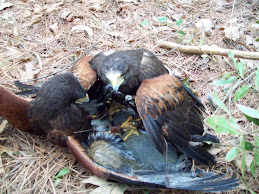
...[T]he real fiend is not the hairless, fanged animal purported to attack and drink the blood of livestock; it's a tiny, eight-legged creature that turns a healthy, wild animal into a chupacabras, says University of Michigan biologist Barry OConnor.The existence of the chupacabras, also known as the goatsucker, was first surmised from livestock attacks in Puerto Rico, where dead sheep were discovered with puncture wounds, completely drained of blood. Similar reports began accumulating from other locations in Latin America and the U.S. Then came sightings of
evil-looking animals, variously described as dog-like, rodent-like or reptile-like, with long snouts, large fangs, leathery or scaly greenish-gray skin and a nasty odor. Locals put two and two together and assumed the ugly varmints were responsible for the killings.
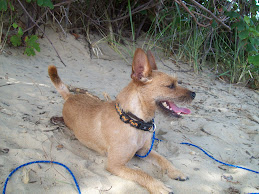
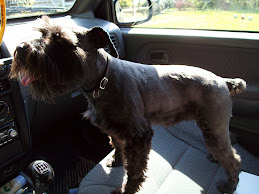
Scientists studied some of the chupacabras carcasses and concluded that the dreaded monsters actually were coyotes with extreme cases of mange -- a skin condition caused by mites burrowing under the skin. OConnor, who studies the mites that cause mange, concurs and has an idea why the tiny assailants affect wild coyotes so severely, turning them into atrocities.
In a recent "Monster Talk" podcast posted on Skeptic magazine's website, OConnor explained that the mite responsible for the extreme hair loss seen in "chupacabras syndrome" is Sarcoptes scabiei, which also causes the itchy rash known as scabies in people. Human scabies is an annoyance, but not usually a serious health or appearance problem, partly because our bodies are already virtually hairless and partly because the population of mites on a given person usually is relatively small -- only 20 or 30 mites.
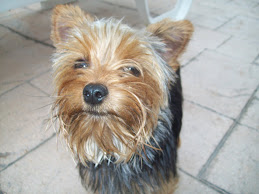
Evolutionary studies done by OConnor and his former graduate student Hans Klompen, now an associate professor at Ohio State University, suggest that the scabies mite has been with us throughout our evolutionary history, giving humans plenty of time to develop defenses. When humans began domesticating animals, Sarcoptes scabiei found a whole new realm of potential victims. Domestic dogs, like humans, have played host to the mites long enough to evolve the ability to fight off mange, but when the condition spreads to wild members of the dog family -- foxes, wolves and coyotes -- watch out.
"Whenever you have a new host-parasite association, it's pretty nasty," said OConnor, a professor of ecology and evolutionary biology and a curator in the U-M Museum of Zoology. "It does a lot of damage, and mortality can be relatively high because that host species has not had any evolutionary history with the parasite, so it has not been able to evolve any defenses like we have."
In these unfortunate animals, large numbers of mites burrowing under the skin cause inflammation, which results in thickening of the skin. Blood supply to hair follicles is cut off, so the fur falls out. In especially bad cases, the animal's weakened condition opens the door to bacteria that cause secondary skin infections, sometimes producing a foul odor. Put it all together, and you've got an ugly, naked, leathery, smelly monstrosity: the chupacabras.
Do mite infestations also alter the animals' behavior, turning them into bloodthirsty killers? Not exactly, but there is an explanation for why they may be particularly likely to prey on small livestock such as sheep and goats.
"Because these animals are greatly weakened, they're going to have a hard time hunting," OConnor said. "So they may be forced into attacking livestock because it's easier than running down a rabbit or a deer."
While the chupacabras has achieved legendary status, other wild animals can suffer just as much from the effects of mange mites, OConnor said. In Australia, the mite is killing off wombats. "They presumably got the mites from dingoes, which got them from domestic dogs, which got them from us," he said.
And a related mite, just as insidious, can drive squirrels to self-destruct. In his graduate school years at Cornell University, OConnor observed mange-weakened squirrels falling from trees. That observation led him to conduct an informal survey to see if mangy squirrels also were more likely than healthy squirrels to end up as road kill. They were, suggesting that being tortured by mites somehow made the squirrels less adept at dodging cars.
Sunday, October 24, 2010
Chupacabra revealed - people are partly to blame


Lady and Starling
Saturday, October 23, 2010
Opening day

I took out Tess by herself.
The plan was to take her out into the woods and get her to follow. But as I waded into the woods, I knew it wasn't going to work. The cobwebs broke across my face and mosquitoes buzzed around my head. The canopy was thick with leaves. Autumn was still a long time coming.
It was after work and the temperature was hovering in the low 70s. Too hot.
The ground cover was so thick you couldn't see the pine needles on the forest floor.
I waded back out and upgraded my plan. I was going to walk along the edge of the woods while calling Tess to and from my fist. I just wanted to get her out and remember what w
 e were doing. Additionally, I knew she was out of shape, so this was an opportunity to get her moving.
It didn't last long.
I meandered along the edge of the wood about ten feet, then Tess bolted towards the interior. I ran to follow. I couldn't see anything due to the leaf cover. Bells rang, silence. The hawk would move - though I couldn't see her, I could hear her.
Then leaves and bark would fall into my eyes and more furious bell ringing.

Then Tess came tumbling from the tree, squirrel in her talons.
Here's to number one.
Sunday, October 17, 2010
Kiwis stink is killing them.

From Scientific American:
Does the natural mushroom-like smell of the kiwi bird help to make it a tempting target for the predators that are eating it out of existence? One scientist thinks so, and he is proposing a deodorant of some kind to protect the birds from extinction.With all five kiwi species endangered, this is research that you shouldn't turn your nose up at. For the first several thousands of years of their existence, New Zealand kiwis (genus Apteryx) did not have to worry about what they smelled like—there were no mammals there to sniff them out, let alone eat them. That changed when humans came to the island, bringing stoats, rabbits, dogs, cats, pigs and a variety of other hungry critters.
There is more to this. Read it here.
Outer Banks Beach Trapping

I got a call from Dan yesterday. He was the NC falconer who got one of the the peregrine falcon trapping tags. We had a good conversation about their trials and tribulations trapping on the Outer Banks. He never did fill his tag.
Neither did Allen, the falconer from Maryland who pulled the other peregrine tag.
I am still learning about this beach trapping thing, but I have made a few observations over the years about trapping in this place I call home. I'm glad Dan left here with a positive attitude, even though he and his friends had many obstacles. And he left without his peregrine. He came in with the right attitude.
Trapping here is tough. Getting good land permission is almost impossible. I had permission on two different tracts of land and we had identified a third possible site on the map. I wanted to see where the birds were.

If you come here to trap - bring four wheel drive. Good four wheel drive. Much of the good trapping sites are through the dunes, where there are no roads. Dan's group got stuck in a hole in a dune track. We'd had lots of rain, there was flooding, and the hole was deeper than they thought. $450 dollars for a tow - w0w.
Anyway. You need four wheel drive, and you need time. we were plagued with high winds and bad weather. And very few birds moving this year. You can't expect to trap a peregrine in two or three days. Could it happen? Sure. But it rarely does.

Plan on a week, maybe more. and lots of time in the blind. Certain weather patterns promise more birds. Not always. North winds seem to provide the most, but they can't be blowing too hard. I can't see not trapping because the winds aren't exactly right. Really, I only need one bird, the right bird, to come to the nets. That could happen any day.
I hear stories about Cape May and Virginia's North shore, Virginia, and ridge trapping. I get emails from guys who are catching 4, 5, 15 birds in a day.
I've never had that happen here. Could my trapping be substandard? am I not doing everything I could? maybe. The fact seems to be that we just don't have the concentrations of birds funneling down our beaches like other areas. I don't know where all the birds go. They seem to disperse once they leave the kiptopeke hawk watch site.
We don't see those numbers.

If you don't have a lot of time, nor are you patient. Don't draw a tag to trap in North Carolina. Make sure you have permission from landowners before you come and know the conditions that you will be facing. Dress and drive appropriately. Plan on disappointment.
Dan and his group treated it like a trapping vacation. They trapped during the day, spending time with friends. they ate well at night. they watched football in the evenings. Treat it like a vacation where instead of golf, or fishing, your spending time with your friends in a 4X4 blind, shooting the breeze and watching birds (or not).
Dan went home with a merlin. Four of the trappers left the beach with merlins. Other birds were trapped and released, merlins and coopers mostly. His bird is flying to him inside the house now and he is starting to think about how to introduce it to game.
Good - he's having fun. That is what falconry should be about.
Saturday, October 16, 2010
moving outside

Training has been pretty predictable thus far.
The little Merlin has been flying to me indoors for a few days. Over ten feet on a dragged creance.
I've had Jocelyn in and out of my classroom full of spastic ten year olds about every other day. As of Thursday, she was flying across the room with the kids in there. I admit, the kids thought it was pretty cool.
And it was.
She is so used to people she didn't even flinch.

So yesterday, we took it outside. Half a dozen flight to the fist. 3 feet, 5 feet 10 feet, and all of them went well, until a gust of wind hit her broadside. The creance brought her to the ground where she sat and looked at me.

Eventually, she hopped, flew, back to me and ate the chick on the ground as I sat next to her. I fed her a few tidbits, and watched her freeze as the cat sauntered past. She waited, while the cat settled herself under a nearby car, then Jocelyn started to pick at the chicken again.
I picked her up, and took her inside. Overall, a good day.
Tuesday, October 12, 2010
Bird Update

It has been seven days. The merlin has been held back due to the reluctant falconer. And a scale gone bad.
Things had been going swimmingly. I admit, these little falcons make me nervous. With their exacting weight management, and skittish nature. But the merlin has been patient.
She spent the day weekend with me and the family at a soccer tournament. She watched the game from the sidelines, sat with the family on the lawn during lunch, a stray dog only steps away, and then came and hung out in a classroom full of spastic 10 year olds all day.
Unhooded. (did I hear a gasp?)
I decided to name her Jocelyn just today. No other name has inspired me. And I am of the belief that falcons need to have traditional names (falcons and owls that is). My kestrels were Romeo and Ulrich.
Anyway - tonight she made the leap.

Her weight was about 165 grams ( I say about cause my scale is doing funny things). She first stepped to the fist for a chicken leg (shoot I'd jump to the fist for a chicken leg).
Then, she hopped. And hopped again. Before it was all over, she'd jumped a dozen times,the last few were over five feet.
All with impeccable grace and poise. Well done Jocelyn.
Tuesday, October 5, 2010
Weekend was a bust - but...

A lot of guys came down this weekend to trap. Two of them had the coveted peregrine tags. Arnaud and I wanted merlins, others were along for the ride. Some are still here - but Mother Nature was not cooperating.
We separated into three groups. Beachfront, soundfront, and mainland. We tried to spread ourselves out to figure out where the hawks were migrating. There just isn't any data for our state about exactly where the highest concentrations are flying.'
So, it was an experiment.
The guys arrived on Friday and checked out where they were going to be setting up their equipment.
Arnaud brought his merlin, so I was able to keep my eye on the prize. Then first thing Saturday morning we split up and went our separate ways.

Arnaud and I stayed in the mainland sight, waiting for the birds, but honestly, they were scarce. A coopers hawk here, a kestrel, etc.
Here is our sparrow bait strapped into a Millican harness, which worked very well. (thanks Johnathan)
The wind was out of the south, we rationalized that the birds weren't coming.
Bon showed up mid afternoon and took my spot, so I headed north and stayed with the boys on the soundside. now to be honest, they could see from one side of the beach to the other. Any bird in the sky, they should have been able to see it.
But the birds weren't there.

Sunday it rained and the wind blew at 20 - 30 miles an hour. We set up the beach site and tried all morning, but it was too miserable and there were no birds in the sky. We gave it a break, then tried again later when the rain had slackened. Merlins zoomed by, the wind carrying them past.
Nothing slowed for more than a second to look at our nets. And to be honest, the gusts were blowing them crazily, making them clearly visible.
The weekend was a bust.

I had taken Monday off - just in case. Everyone else set up along the beach, I opted for the mainland. I sat through the day and saw only one coopers. He came right to the pigeon, but landed behind the nets. I tried to scare him into the nets, but he flew off. And that was it.
I called it a day at 2:00. I packed up, knowing that my trapping chances were over. I was trying to come up with plan B. Maybe a kestrel?

Not sure.
On the way home I get a call from Arnaud on the north beach. They're seeing falcons and he's trapped a merlin.
After a few frantic phone calls, I change my plans, rearrange the kids ride schedules, then head north. There were a few hours of sunlight left.

I rode down the blowing sandy beaches, keeping to the ruts in front of me. I crossed the dune, and drove through the fields and past some local wildlife. I noticed none of it. I was frantic to get there.
When I got there Arnaud had trapped another bird, a male this time. he had figured out the secret to merlin trapping on the Outer Banks.
It was the merlin
 tree. He set up behind it and it drew the birds in. weird.
By the time I left the trap site that night, there was another female merlin sitting on t
 he seat next to me. She was trapped at 208 grams and is a gorgeous chocolate brown.
Still looking for a name.
and there are some guys still looking for their falcon.
I'll keep you posted.
Friday, October 1, 2010
Intelligent birds

Many people give birds a bad rap. They think of them as simple creatures that simply eat and poop on their cars. Research has over and over proved that this is not true. Science Daily lays out the basic argument:
The level of intelligence in birds, as a scientific inquiry, has not been as thoroughly researched as similar questions regarding primates and other mammals.However, there is a general belief that they are more intelligent, as a class, than the reptiles, and that many species are just as intelligent as mammals of comparable size.
Because birds lack forelimbs with which to modify their surroundings, it is often difficult to test for intelligence as we would define it for mammals.
Traditionally, biological science has maintained that most actions performed by birds that may indicate intelligence are merely ingrained instinctual behaviours and that birds are unable to learn.
While parrots have the distinction of being able to mimic human speech, studies with the African Grey Parrot have shown that some are able to associate words with their meanings and form simple sentences.
Along with parrots, the crows, ravens, and jays (family Corvidae) are perhaps the most intelligent of birds..
For more information about the topic Bird intelligence, read the full article at Wikipedia.org,
Wednesday, September 29, 2010
Dry Run
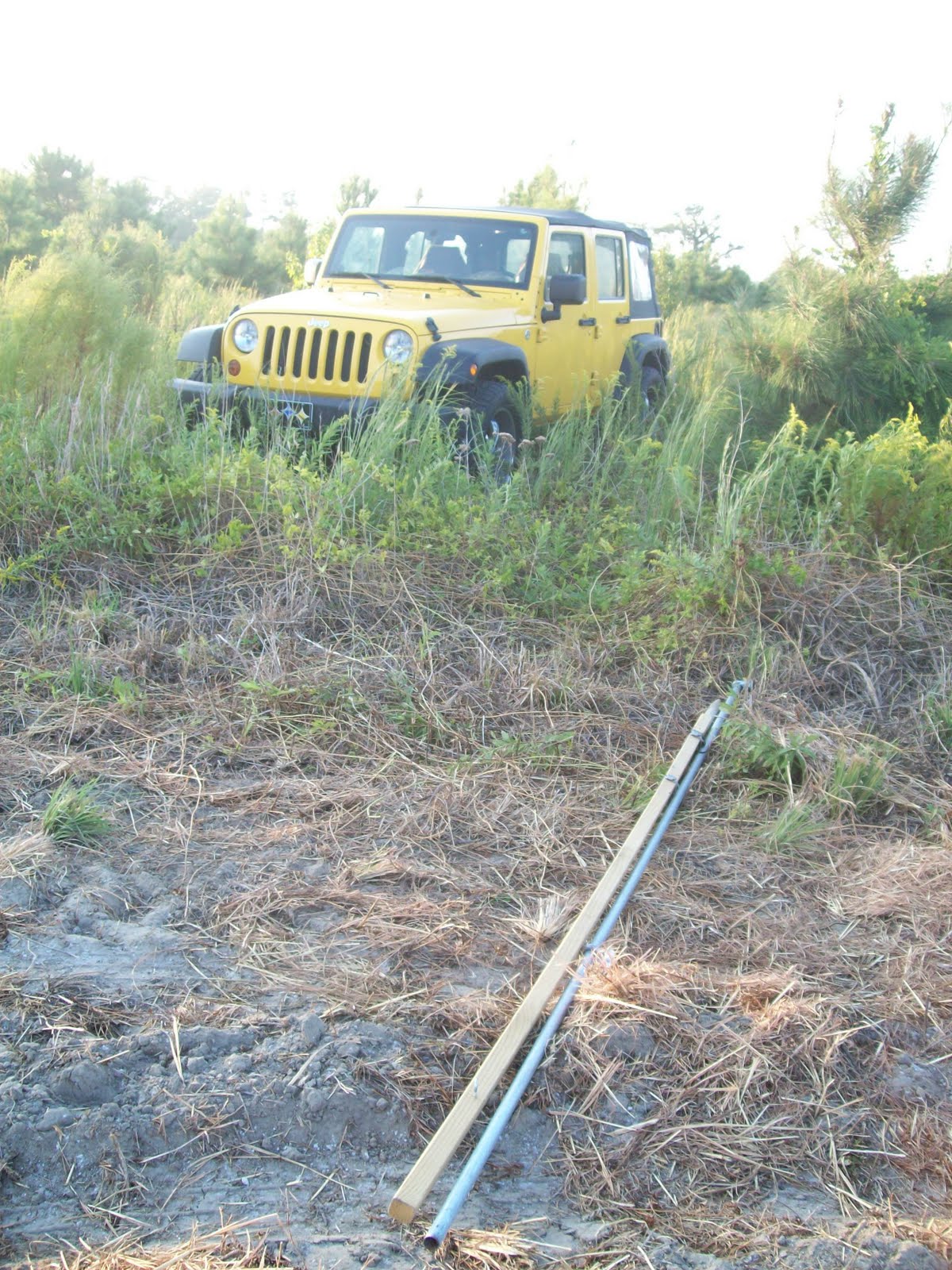
I took the blind, nets, and bait birds out for a dry run on Saturday. It was my first day off in I don't know how long, and all the trapping indicators were wrong.
But that is alright, I just wanted to give it a try.
I set up the nets Friday night, leaving them collapsed, but ready. Bait poles were hung with lure line and ready for the bait birds. I slept roughly Friday night. Often before a big outing, I can't sleep This was like that.
I got out of bed before my alarm and made it to the trap sight as the sun crested the horizon. I finished setting up, strung up the nets, and placed the bait birds on their strings.
The wind was perfectly wrong, 10 miles an hour and coming pretty directly from the South. I only needed to trap one bird though, only one bird migrating through the area.
Everything pointed almost directly North, the nets set in a V around the bait.

Then I waited. Egrets flew into the field and started picking at the ground, and quail took dust baths in the distance.
A single merlin blew by me, paying no mind to nets, bait, or other enticements. It just winged its way south.
Then Nothing. The sun moved high in the sky, and nothing.

I left the blind to stretch, only to see a peregrine pursuing another bird. They swirled and twirled in reckless abandon, zig-zagging their way across the field, then ringing straight up to the sky, and plunging back down, skimming the ground.
Gone - over the horizon, then nothing.
I pulled and pulled on the bait pigeon. Nothing flew over, only vultures and crows.
Vultures and crows.
The day ended with a Merlin, flying low over the nets, checking out the bait. It noticed the bait, but never really slowed.
A full day listening to my own inner dialogue with no action in the nets at all.

But, the tension in my neck was gone, I was calm, relaxed.
Maybe I need to spend more time doing nothing for hours on end. It might be good for me.
Saturday, September 25, 2010
Turtle love

I admit it. I've gotten out of the habit of checking other blogs and writing my own. I promise to do better.
Things have been crazy here and It's all I can do to keep up. Fortunately, my schedule is starting to clear a bit. It cleared enough that we were able to go out and check on a turtle nest that we had heard about.
Our friends were lucky enough to be there when the momma laid her eggs.
I was shuttling the boys home from boy scouts, and we were supposed to meet the girls out there.

I was late and missed it, but the girls got to see one of the little buggers shuffle his way down to the surf.
While we waited for any new arrivals, my talented wife decided to take advantage of the harvest moon and take some pictures.


Wednesday, September 15, 2010
Whatcha doing?

Gettin' ready. This time of year is real busy. I'm working two jobs, seven days a week. Trapping season is soon upon us. Soccer for the kids has begun in earnest - That's three traveling teams and the middle school team for the oldest.
Oh - and I'm in a triathlon this weekend.
I think that's enough.
But in between driving here and there, work, wine and song - I've been getting nets ready.
I'm trying a new design for my small nets. I have stolen the idea from a net that Andrew had when we were trapping last year.

I've taken and made stationary posts out of 1.5 inch pvc. I painted it camo (cause I think its funny that they have a paint color 'camo'). Now I can theoretically drive around with the nets set up in the back of the car, ready to set it up at a moments notice.
On the single leg in back I've drilled holes so that I can attach a bait bird to the net structure itself.
The rings on the side are to let the net collapse around the caught bird, without having the
 untangling issues I've had in the past.
I've left holes open in the bottom of the uprights as well, so I can still stake the whole structure to the ground. I had a peregrine last year blow through the net, pull down the poles, untangle itself, and then fly off before I could get to it.
Heart wrenching.
I don't think that can happen here.
For a release mechanism I use clothespins attached loosely to the ends of zip ties. Eric Edwards has pictures of the same mechanism on his nets.
Next I work on the lure poles - trapping will be here soon.
Oh - and Tess is at weight, ready to hunt. 905 grams today.
I changed her jewelry, and as soon as I have an opening in the schedule, we try some car hawking.
Thursday, September 9, 2010

We're close

Weight management is the key to successfully hunting with any raptor. Some people like the challenge in maintaining a more difficult to manage bird. I don't, as a general rule.
I want my falconry to be fun and hassle free.
For me, harris hawks fit the bill.
Both my birds, at weight, are easy to get along with and biddable. They come to the whistle, every time - but they also come to the call of their name. They roam ahead early in the hunt, and leapfrog over one another as they check out new terrain.
One quests forward, while the other hangs back and watches for movement. They know the game, and they are experts at playing it.

Over the last month I have been slowly cutting the amount of food that they receive by about a quarter. It takes about two mice a day for the birds to maintain their wight as the nights begin to cool (hawks loose more weight in lower temperatures). So I feed them two mice one day, one the next, and they slowly drop the weight.
Tess is about there.
At 940 grams, she would go and hunt right now. By the end of last season, she was hunting
 around 960 and performing impeccably. But squirrel season still doesn't open for about a month, so if I am going to hunt, I'll be hunting birds.
Most likely out the car window.
To do that, I need her just a little bit lower. She should be ready early next week.
It's time to start clearing the calender.
Friday, September 3, 2010

Cruising south down the beach road was an experience.


I'm glad I decided to take the jeep.


After a few miles you realize why all the houses around here are built on stilts.

As the day wore on, Earl pulled farther from shore and everything seemed to return to normal.